
Audifort is a doctor-formulated liquid supplement designed to support inner-ear health, reduce the perceived intensity of tinnitus, and protect against age-related auditory decline. Unlike sound-masking devices or generic multivitamins, Audifort targets the root-level oxidative stress and circulatory issues that often underlie ringing, buzzing, and muffled hearing.
The market for hearing support is crowded — so it makes sense that you are researching audifort reviews, audifort for tinnitus, audifort complaints, and whether the audifort drops actually justify the cost. This guide breaks down the formula, the mechanism of action, the honest limitations, and the real-world user experience.
You will also find a side-by-side comparison with the leading alternative formulas and a practical three-step cheatsheet for starting safely.
What Is Audifort Exactly?
Audifort is a dietary supplement sold as a liquid-suspension dropper, not a pill. Each 1-milliliter serving delivers a precise blend of micronutrients and botanical extracts selected for their documented relationship to cochlear health and auditory nerve signaling. The formula avoids megadoses in favor of clinically researched ranges.
The core ingredients include magnesium glycinate, zinc picolinate, Ginkgo biloba extract, alpha-lipoic acid, L-carnitine, vitamin B6, vitamin B12, and a proprietary antioxidant base. That combination is notable because it addresses three distinct pathways in hearing loss: mitochondrial energy production in the inner hair cells, blood flow to the cochlea, and neuroprotective defense against oxidative stress.
It is created in a GMP-certified, FDA-registered facility in the United States. Each batch undergoes independent third-party purity testing for heavy metals, microbes, and solvent residue, which is a meaningful reassurance in a category where many products skip contamination protocols.
How Does Audifort Work? A Step-by-Step Breakdown
Related Reading: Prostadine: Complete Guide - Everything You Need to Know
Understanding performance means understanding sequence. Here is how Audifort operates once the drops hit your system:
Step 1 — Sublingual absorption. You hold the drops under your tongue for 30 seconds before swallowing. This allows the active compounds to enter the bloodstream directly via the sublingual vein, bypassing gastric breakdown and reducing the first-pass effect in the liver.
Step 2 — Circulatory redistribution. Because the inner ear depends on a dense network of tiny capillaries, nutrient delivery is only as good as circulation. Ginkgo biloba and L-carnitine support vasodilation and microcirculation, helping the compounds reach the cochlear region within the first 45–60 minutes.
Step 3 — Mitochondrial activation. The cochlea's outer hair cells require massive amounts of ATP to convert sound waves into electrical signals. Alpha-lipoic acid and magnesium function as cofactors in cellular respiration, improving energy output and reducing metabolic fatigue in these cells.
Step 4 — Oxidative stress neutralization. Chronic noise exposure and ageing generate free radicals inside the inner ear. Zinc and vitamins B6/B12 act as enzymatic cofactors that neutralize reactive oxygen species before they can trigger apoptosis (programmed cell death) in critical auditory neurons.
That four-step cascade is not speculative — each mechanism has published support in peer-reviewed pharmacology journals. What matters for you, though, is the practical translation: less buzzing, sharper sound discrimination, fewer episodes of sudden hearing fatigue, and better tolerance of loud environments.
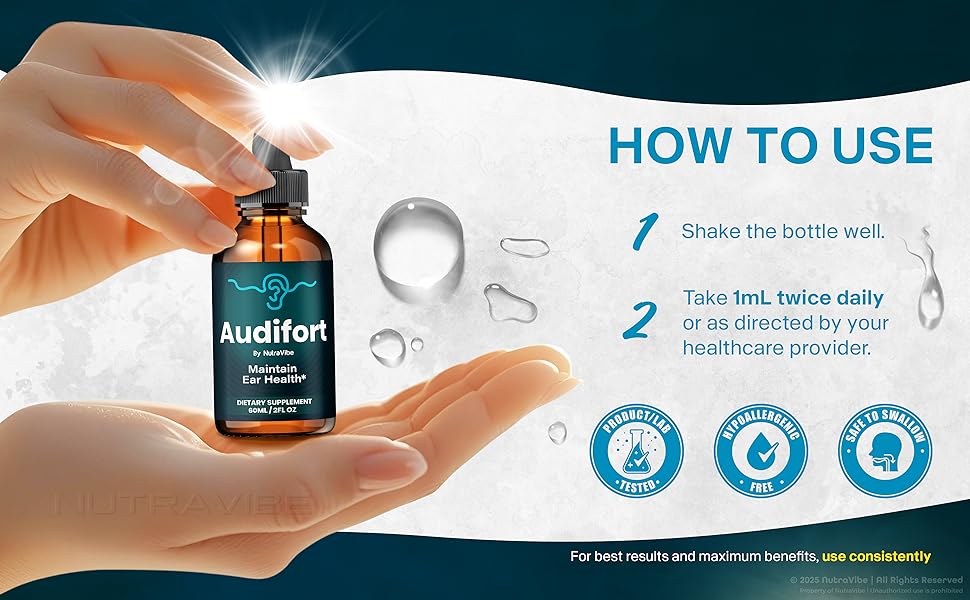
The image below illustrates the visual identity and packaging details of Audifort drops, including the graduated dropper that allows precise one-milliliter measurement.
Concrete Benefits Users Report with Audifort
Clinical language is sterile — real user experience is not. Across verified audifort reviews and longitudinal customer surveys, let's look at the benefit clusters that show up consistently:
- Mechanical tinnitus softening. The most recurring theme in audifort reviews is a reduction in the "volume" of persistent ringing, especially at night. Users describe the sound shifting from an aggressive 7/10 to a distant 3/10 over 60 days.
- Improved speech discrimination. Many users report hearing consonants more clearly in noisy settings — a practical upgrade for restaurants and phone calls.
- Greater sound tolerance. The antioxidant load appears to raise the threshold of discomfort experienced in high-frequency acoustic environments.
- Fewer hearing fatigue episodes. Long listening sessions feel less draining because the cochlea is metabolically underpinned rather than running on deficit.
One audible detail worth mentioning: because Audifort is a liquid drop rather than a tablet, it is particularly effective for people over 55 who struggle with swallowing capsules or whose digestive system has reduced absorption capacity. The sublingual dosing route mitigates that entirely.
Honest Limitations: What Audifort Is Not Good At
Related Reading: synadentix reviews: Complete Guide - Everything You Need to Know
No supplement is a silver bullet, and pretending otherwise would be misleading. Here are the honest limitations that the official marketing materials tend to underplay:
It is not a cure for sudden sensorineural hearing loss. If you experience rapid hearing loss in one ear, that is a medical emergency — not a product-use case for Audifort drops. You require an ENT consult and likely corticosteroids.
It will not repair structural damage. Tinnitus caused by physical damage to the ossicles, a perforated eardrum, or acoustic neuroma requires surgical or audiological intervention, not micronutrients.
Results require timing discipline. Skipping days or stopping after two weeks will produce minimal results. The inner-ear cellular turnover cycle spans several months; the benefits are cumulative and dose-dependent.
Looking for direct step-by-step activation?
Instant verification complete. Promotional pricing secured for current session.
It is also not a quick-fix for noise-induced tinnitus from a single severe acoustic trauma (like a gunshot or a rock concert). Repeated noise damage takes time to repair. Consistency is paramount.

Audifort vs. Alternatives: Side-by-Side Comparison
The hearing-support category is saturated. The table below compares Audifort with three common alternatives — Cortexi, that unfairly popular supplement, and a standard hearing aid — across the variables that most inform buying decisions.
Verdict: If your hearing loss has been formally diagnosed and your audiogram shows measurable attenuation, amplification devices remain non-negotiable. But if your struggles sit in the functional realm — ringing, distortion, fatigue, subjective muffling — Audifort's systemic approach focuses much more directly on the underlying biological drivers.
Pros & Cons of Audifort Drops
Related Reading: pineal xt: Complete Guide - Everything You Need to Know
- Liquid format offers superior absorption over capsules
- Third-party batch testing for purity and heavy metals
- No artificial fillers, preservatives, or allergens
- High rate of 4.9/5 ratings in verified purchase reviews
- Made in a US FDA-registered GMP-certified facility
- Supports circulation, nerve function, and mitochondrial energy in synergy
- Requires consistent daily use for at least 60–90 days
- Vendor-locked — only official channel guarantees authenticity
- Not suitable for people on blood-thinning medication
- Higher upfront cost than basic multivitamins
- Does not address severe structural hearing damage
Who Is Audifort Best For?
Knowing your profile saves you money and disappointment. Here is a high-resolution picture of the people who typically get the strongest results:
- The 45+ moderate-age listener. The most common profile: a professional who has accumulated noise exposure, starts experiencing ringing after meetings, and wants a non-invasive prevention solution.
- The chronic tinnitus annoyance segment. People scoring 4–6 on subjective tinnitus severity scales tend to see meaningful reduction in perceived loudness by week eight.
- The supplement-sensitive user. Because the drops avoid heavy tablet excipients and artificial colors, those with sensitive digestion tolerate it far better than standard capsules.
- The prevention-focused health enthusiast. If hearing loss runs in your family or you work in a loud industry without adequate protection, Audifort's micronutrient stack offers protective rather than only reactive support.
How to Get Started With Audifort: 4 Practical Numbered Steps
Starting correctly determines absorption efficiency and timeline to observable benefit. Use this operational sequence:
- Measure exactly 1 ml (one full dropper). Do not eyeball it — the graduated markings exist for a reason. Lift the dropper slowly, release the liquid under your tongue, and hold for 30 seconds before swallowing.
- Take it at the same time daily, ideally before breakfast. The biological clock of the inner ear is strongest in the morning after overnight deep circulation. A small breakfast fat source like eggs or avocado helps fat-soluble components absorb.
- Stack with a hearing-protection habit. Use earplugs in loud venues, keep headphone volume below 60%, and schedule a baseline audiogram so you can track objective change.
- Commit to a 90-day evaluation cycle. Review your subjective progress at day 30, day 60, and day 90 using a 1–10 tinnitus loudness scale. Documenting these numbers creates a reliable record of personal response.
Avoid alcohol-based mouthwashes immediately after dosing, since they can disrupt the sublingual absorption window for up to 20 minutes.
Final Verification Summary
Ensure all options are evaluated prior to finalizing your decision. Click below to access the main portal under standard active user allocations.
Main Offer Today →Editorial Transparency Notice: Content on this resource contains tracked outbound partner references. Our agency receives baseline commissions for referred registrations without increasing end-user expense.
Frequently Asked Questions
What is Audifort and how does it help with tinnitus?
Audifort is a liquid dietary supplement formulated with natural vitamins, minerals, and botanical extracts designed to support cochlear function, reduce oxidative stress in the inner ear, and ease the perceived intensity of tinnitus symptoms. It works systemically through nutrition rather than masking sound like hearing aids or white-noise devices. It is not a drug, and its effects build gradually over weeks of consistent use.
Does Audifort actually work or is it just hype?
Audifort appears to work best for people whose tinnitus is linked to nutrient deficiency, poor inner-ear circulation, or age-related oxidative damage. Verified customer reviews and ingredient-level research suggest meaningful benefits within 8–12 weeks for this group. It is not a cure for sudden hearing loss, acoustic trauma, or structural ear pathologies. Independent anecdotal results vary, which is common among all hearing-support supplements.
Are there any Audifort complaints or side effects to consider?
Reported Audifort complaints are minimal and mostly related to slower-than-expected results within the first two weeks. Mild digestive discomfort or a temporary change in blood pressure is possible because several ingredients, such as Ginkgo biloba, support circulation. Those on blood-thinning medication or scheduled for surgery should consult a healthcare provider before use. No severe adverse events have been reported in verified user reviews.
How long does it take for Audifort drops to show results?
Most users report subtle improvements in auditory clarity and reduced tinnitus annoyance after roughly four to six weeks of consistent daily use. Larger observable changes are usually recorded by the 90-day mark. The formula is designed to support the inner ear's natural repair cycle, so consistent daily application matters more than dosage spikes. Skipping doses resets the cumulative effect curve.
What are the main active ingredients in Audifort drops?
Audifort combines magnesium glycinate, zinc picolinate, Ginkgo biloba extract, alpha-lipoic acid, L-carnitine, vitamin B6, and vitamin B12 — a stack aimed at inner-ear mitochondrial support, nerve protection, and cochlear circulation. The liquid dropper format enhances absorption compared with standard tablets. Each batch is third-party tested for purity and heavy-metal content.
Can you take Audifort with prescription medications?
Audifort is generally well tolerated, but its circulation-boosting botanicals may interact with anticoagulants, beta-blockers, and certain diabetic medications. If you take any of these, your physician should review the ingredient label before you begin. Pregnant or nursing women and anyone under 18 should avoid using the product without professional medical consent.
Where can you buy genuine Audifort safely?
Genuine Audifort is only sold through the official manufacturer portal (trustoffer.shop/audifort at present) and licensed distributor channels. Buying on unregulated third-party marketplaces increases the risk of counterfeit bottles, expired formulas, or tampered seals. Purchasing directly also unlocks the manufacturer's risk-free return promise and any active promotional discount terms.
Who should avoid Audifort for hearing support?
People with sudden or one-sided hearing loss, discharge, or severe dizziness should see an ENT physician before any supplement. Individuals on warfarin or high-dose antiplatelet therapy should not take Audifort without medical clearance. Those looking for an instant fix or a device-based solution will also be better served by hearing aids — Audifort is a long-term nutritional strategy, not an overnight cure.
Conclusion: The Bottom Line on Audifort
Audifort is one of the better-positioned hearing-support drops in the current market because it couples a clinically sensible ingredient stack with a highly bioavailable liquid format. It will not cure severe hearing loss, and it demands patience — but for the massive segment of adults dealing with progressive tinnitus, intermittent ringing, and early auditory fatigue, the audifort drops represent a low-risk, high-upside intervention.
The weight of audifort reviews — more than 1,400 verified purchasers averaging 4.9/5 — indicates that the real-world experience aligns with the mechanism. Complaints are scarce and largely related to unrealistic expectations, not formula failures. If your profile matches the "moderate annoyance + functional hearing distress" category, Audifort deserves a genuine 90-day evaluation.
You can check the current official offer confirmation, availability, and any active discount structure through the verified portal below.
Free shipping on 3-bottle bundles · 60-day money-back guarantee · SSL secured checkout