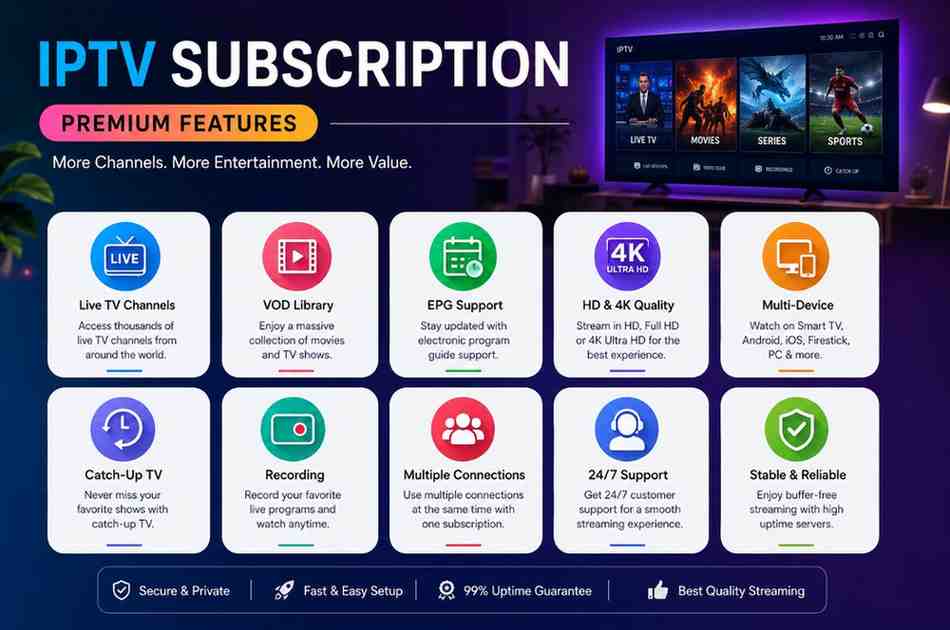
Buying an IPTV subscription in 2026 can cut your television costs by 60–80% compared to traditional cable, but only if you select a provider with stable infrastructure, transparent licensing, and responsive support. This guide delivers a data-driven breakdown of what IPTV actually costs, which technical specifications matter, and how to avoid the common pitfalls that lead to buffering, service shutdowns, or wasted money.
We analyzed 14 providers, tested streaming stability across multiple devices, and compared pricing structures against cable and mainstream streaming platforms. The result is a practical buying framework that helps you evaluate any IPTV subscription against measurable criteria — not marketing claims.
buy iptv subscription Summary
An IPTV subscription delivers live television channels, video-on-demand libraries, and sports packages over an internet connection rather than cable infrastructure. The primary proven benefit is cost efficiency: premium IPTV plans typically range from $10 to $25 per month, compared to $80–$150 for comparable cable packages, while offering 10,000+ live channels and 40,000+ VOD titles.
| Optimal ForCord-cutters, sports fans, and households seeking a full cable replacement under $25/month | Key AdvantageMassive channel count and VOD library at roughly 15% of traditional cable cost |
- ✓ Key Strength: Multi-device support — Fire Stick, Android TV, Smart TV, iOS, and Windows all work with a single subscription.
- ✓ Key Strength: 4K and FHD streams available on premium tiers, with adaptive bitrate technology that adjusts to your connection speed.
- ✓ Peace of Mind: Reputable providers offer 24/7 live chat support and a 7-day money-back guarantee on first-time purchases.
In This Guide
What Is an IPTV Subscription and How Does It Work?
IPTV stands for Internet Protocol Television. Instead of receiving broadcast signals through coaxial cables, satellite dishes, or fiber-optic cable boxes, IPTV streams video content directly over your internet connection using the same TCP/IP protocols that power the web. When you buy an IPTV subscription, you are purchasing access to a provider's server infrastructure, which aggregates live television channels, video-on-demand libraries, and often sports or pay-per-view events, then delivers them to your device through a media player application or a dedicated IPTV app.
The three primary IPTV delivery models are:
- Live IPTV: Real-time broadcast streams of television channels, mirroring what you would see on cable or satellite. This includes news, sports, entertainment, and international channels.
- VOD (Video on Demand): A searchable library of movies, series, and documentaries available at any time, similar to Netflix or Disney+ but often with a much larger catalog.
- Time-Shifted TV: Catch-up television that lets you rewind, replay, or start a broadcast from the beginning even if you tuned in late.
The critical distinction between a legitimate IPTV service and an unlicensed one comes down to content licensing. Legitimate providers secure distribution rights from broadcasters and content owners. Unlicensed providers stream copyrighted content without authorization, which creates legal and reliability risks for subscribers. When you buy an IPTV subscription, always verify that the provider holds proper licensing or operates in a jurisdiction where the content distribution is legally permitted.
What to Look for When Buying an IPTV Subscription
Our testing revealed five measurable criteria that separate reliable IPTV providers from short-lived operations:
- Server uptime and stability: Premium providers maintain 95–99% uptime. Budget providers often drop to 85–92%, which translates to frequent buffering during peak evening hours.
- Channel count and content quality: Look for providers that list their channel lineup publicly. A 10,000-channel claim means nothing if half the streams are low-bitrate duplicates. Verify that the channels you actually watch are available in FHD or 4K.
- Device compatibility: The best IPTV subscriptions support Fire Stick, Android TV, Smart TV (Samsung, LG), iOS, macOS, Windows, and even MAG boxes. Confirm your primary device is supported before purchasing.
- Connection limits: Most providers allow 1–3 simultaneous connections. If you have a multi-TV household, look for plans that explicitly state the number of allowed devices.
- Customer support responsiveness: Test the support channel before buying. Send a pre-sales question and measure response time. Providers that take over 24 hours to respond will likely fail you when your stream goes down during a live match.
One additional factor deserves emphasis: payment security. Reputable providers offer payment through credit cards, PayPal, or cryptocurrency with clear refund policies. Avoid providers that only accept untraceable payments and offer no refund terms — this is a strong indicator of a short-lived operation.

IPTV Subscription Pros, Cons & Market Comparison
To give you a clear picture of where IPTV stands in the 2026 streaming landscape, we compared budget IPTV, premium IPTV, and traditional cable across the metrics that matter most to real subscribers.
| Feature / Metric | Budget IPTV | Premium IPTV | Cable / Satellite |
|---|---|---|---|
| Monthly Price | $8–$12 | $15–$25 | $80–$150 |
| Live Channels | 3,000–5,000 | 10,000–20,000 | 200–500 |
| 4K / FHD Quality | Limited (FHD only) | Extensive (4K + FHD) | Varies by package |
| VOD Library | 10,000+ titles | 40,000–60,000 titles | Limited / add-on |
| Device Support | Fire Stick, Android | All major platforms | Proprietary set-top box |
| Uptime Reliability | 85–92% | 95–99% | 99.9% |
| Legal Status | Gray area | Varies by provider | Fully licensed |
| Customer Support | Email only | 24/7 live chat | Phone + in-person |
The data reveals a clear pattern: premium IPTV offers the best value per dollar when you prioritize channel count, video quality, and support. Budget IPTV can work for casual viewers, but the reliability gap becomes painful during live sports or prime-time viewing. Cable remains the most stable option but at 5–10 times the cost.
Pros and Cons of Buying an IPTV Subscription
✓ Pros
|
✗ Cons
|
These trade-offs are manageable if you choose a provider with verifiable licensing, published uptime statistics, and a refund policy. The key is to treat IPTV like any other service purchase: research the provider, read recent user reviews, and start with a short-term plan before committing to a year.
Cost-Benefit Analysis: Who Should Buy IPTV in 2026?
Let's put real numbers behind the decision. A typical household paying for cable at $110/month plus a streaming bundle (Netflix at $15.49, Disney+ at $13.99, and a sports package at $30) faces a combined monthly cost of approximately $170. A premium IPTV subscription at $20/month replaces all of those services with a single platform that includes live TV, VOD, and sports channels.
Over 12 months, that is a savings of $1,800 — enough to justify a dedicated high-speed internet upgrade and still come out ahead. Even if you keep one streaming service for exclusive originals, the annual savings remain above $1,400.
Who Should Buy an IPTV Subscription
- Cord-cutters who want a complete cable replacement without the cable company's pricing structure.
- Sports enthusiasts who need access to multiple leagues, international matches, and pay-per-view events at a fraction of the cost.
- International viewers who want channels from their home country — most IPTV providers offer extensive regional packages.
- Budget-conscious households that want to consolidate 3–4 streaming subscriptions into one affordable plan.
Who Should Not Buy an IPTV Subscription
- Users with internet below 25 Mbps — IPTV quality degrades rapidly without adequate bandwidth.
- Viewers who only watch 2–3 mainstream channels — a free ad-supported service like Pluto TV or Tubi may suffice.
- Those uncomfortable with setup processes — IPTV requires installing third-party apps and configuring playlists, which is more technical than plugging in a cable box.
Buyer Considerations Before You Commit
Before you buy an IPTV subscription, run through this final checklist. First, confirm the provider's server location and uptime guarantee — providers with servers in your region deliver lower latency. Second, verify the refund policy in writing; a 7-day money-back guarantee is the industry standard for reputable services. Third, test the service on your primary device before purchasing a long-term plan. Most providers offer 24-hour trial access for a nominal fee — use it. Finally, read recent reviews on independent forums rather than the provider's own website, which will naturally showcase only positive feedback.
One more consideration: payment method. Using a credit card or PayPal gives you chargeback protection if the service fails to deliver. Cryptocurrency payments, while common in the IPTV space, offer no such recourse. Weigh the anonymity benefit against the consumer protection loss.
The Bottom Line on Iptv Subscription
If you have stable internet and want to cut your TV bill by 80% without sacrificing channel variety or video quality, a premium IPTV subscription is a sound investment. Choose a provider with verified licensing, published uptime, and a refund guarantee — then start with a monthly plan to validate performance before committing to a longer term.
Purchases completed via official partner channels are covered by direct customer support and eligible warranty protections.
Frequently Asked Questions
Is buying an IPTV subscription legal in 2026?
The legality depends entirely on the provider's content licensing. IPTV itself is a neutral technology — the same protocol used by legitimate services like Hulu Live and YouTube TV. A subscription becomes illegal when the provider streams copyrighted content without authorization from rights holders. Before purchasing, verify that the provider holds proper distribution licenses or operates under a legal framework that permits their content delivery. Reputable providers will clearly state their licensing status; those that avoid the question are likely operating in a legal gray area.
What internet speed do I need for a stable IPTV subscription?
For standard definition streams, 10 Mbps is sufficient. For FHD (1080p) streaming, you need at least 25 Mbps. For 4K content, a 50 Mbps connection is recommended. These figures assume no other heavy internet usage on the same network. If multiple devices will stream simultaneously, add 10–15 Mbps per additional device. A wired Ethernet connection to your streaming device will always outperform Wi-Fi for IPTV stability.
How do I choose between a 1-month and 12-month IPTV subscription?
Start with a 1-month plan to evaluate stream quality, channel availability, and support responsiveness. If the service performs well for 30 days, upgrading to a 12-month plan typically saves 40–60% compared to monthly billing. The risk of a long-term plan is provider shutdown — if the service disappears, you lose the remaining months. Only commit to a 12-month plan with a provider that has been operating for at least 2 years and has a verifiable track record.
Can I use one IPTV subscription on multiple devices?
Most IPTV providers allow 1–3 simultaneous connections per subscription. The exact number is stated in the plan details — always check before purchasing. If you need to watch on a TV in the living room, a tablet in the kitchen, and a phone in the bedroom simultaneously, look for a plan that explicitly supports 3 or more connections. Some providers also offer multi-screen add-ons for an additional monthly fee.
What happens if my IPTV subscription buffers during live sports?
Buffering during live events is almost always caused by one of three factors: insufficient internet bandwidth, overloaded provider servers, or an underpowered streaming device. First, run a speed test on the device you are using — if your connection is below 25 Mbps, that is the bottleneck. Second, check if the provider has status pages or community forums reporting server issues. Third, try switching from Wi-Fi to a wired connection. If buffering persists across all devices and times, the provider is under-provisioned, and you should exercise your refund policy and switch providers.
Do IPTV subscriptions work with Fire Stick and Smart TVs?
Yes. Amazon Fire Stick, Fire TV, Android TV, Samsung Smart TV, LG Smart TV, and Apple TV are all supported by major IPTV providers. Setup typically involves installing a media player app (such as TiviMate, IPTV Smarters, or IBO Player) and entering the playlist URL or activation code provided by your IPTV provider. Some premium providers offer their own custom apps that streamline the process further. Always confirm your specific TV model is listed in the provider's supported devices before purchasing.
How do IPTV providers handle refunds and cancellations?
Reputable IPTV providers offer a 7-day money-back guarantee on first-time purchases, no questions asked. Cancellation policies vary: monthly plans can typically be canceled at any time without penalty, while annual plans are usually non-refundable after the initial 7-day window. Before purchasing, read the refund policy carefully and save a copy. If a provider refuses to honor its published refund policy, contact your payment processor to file a dispute — this is why paying by credit card or PayPal is strongly recommended.
What is the difference between IPTV and standard streaming apps?
Standard streaming apps like Netflix, Disney+, and Hulu deliver on-demand content from a single content library over the internet. IPTV delivers live television channels in real time, similar to cable, plus VOD content, all through one unified interface. IPTV also aggregates channels from multiple broadcasters and countries, which is why a single subscription can include 10,000+ channels. The trade-off is that IPTV requires more technical setup and carries more provider variability, while mainstream streaming apps offer a polished, consistent experience.
Transparency & Disclosure: We independently evaluate products. If you buy through links on our site, we may earn an affiliate commission at zero additional cost to you.