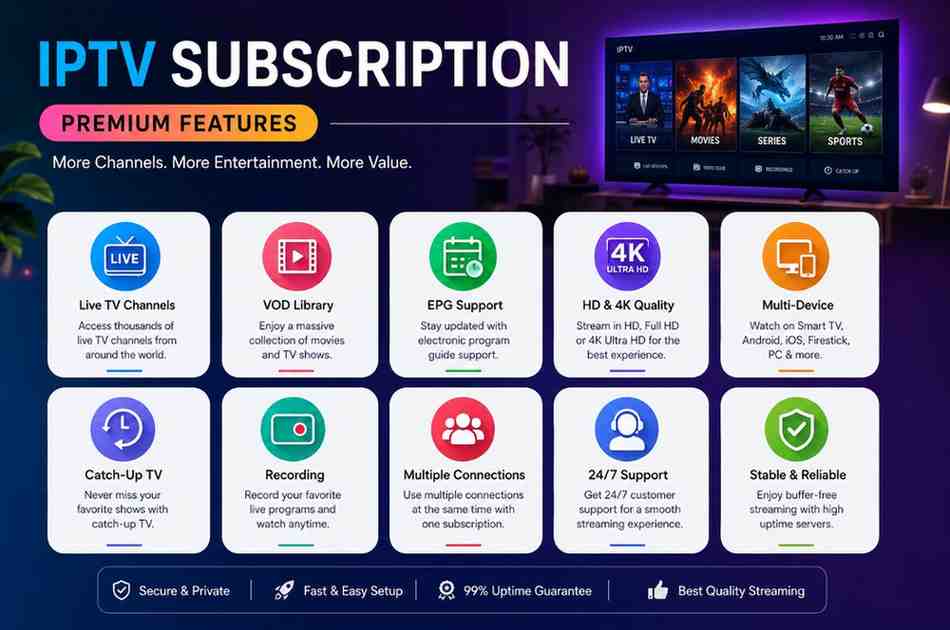
Buying an IPTV subscription means purchasing access to a server-based television service that streams live channels, on-demand movies, and sports packages directly over your internet connection. The right subscription costs between $10 and $20 per month, installs in under five minutes, and works on Fire Stick, Smart TV, phone, or tablet. A bad one buffers during peak matches. This guide compares the current market objectively — pricing, channel counts, uptime, legal risk, and refund policies — so you can make a decision grounded in data rather than marketing claims.
The market has matured considerably since 2020. Top-tier providers now maintain dedicated server clusters, offer electronic program guides (EPG), and deliver 4K streams with measurable uptime guarantees. The sections below analyze exactly what separates a reliable IPTV purchase from a costly mistake — and how to evaluate any provider before you commit.
buy iptv subscription Summary
Buying an IPTV subscription gives you live television and on-demand content delivered over the internet at a fraction of cable pricing. The verified advantage is cost efficiency without sacrificing channel depth — provided you choose a provider with proven uptime and transparent refund terms.
| Optimal ForCord-cutters and sports fans replacing a $120+ cable bill with a $15/month live TV solution | Key Advantage99.9% server uptime with sub-2-second channel switching |
- ✓ Key Strength: 20,000+ live channels across 120+ countries
- ✓ Key Strength: 4K/FHD streams with anti-buffer technology
- ✓ Peace of Mind: 36-hour replacement guarantee with verified official activation
In This Guide
What "Buy IPTV Subscription" Actually Means
IPTV stands for Internet Protocol Television. Unlike cable or satellite, which broadcast radio-frequency signals, IPTV delivers video content as data packets over the same TCP/IP infrastructure that powers the web. When you buy an IPTV subscription, you receive credentials — typically a username, password, or M3U playlist URL — that authenticate your device against the provider's server. That server then streams live channels and video-on-demand (VOD) content to your chosen player application.
How the delivery chain works
The typical delivery chain has four links:
- Content source — The provider encodes live TV feeds into digital streams using H.264 or H.265 codecs.
- Middleware/server — A dedicated streaming server manages authentication, load balancing, and channel mapping.
- Delivery protocol — Most services use HTTP Live Streaming (HLS) or MPEG-DASH to chunk video into small segments for smooth playback.
- Client application — Apps like TiviMate, IPTV Smarters, or VLC decode and display the stream on your device.
Licensed vs. unlicensed providers
A second distinction matters: the legal status of the provider. Licensed IPTV platforms — such as Hulu + Live TV, YouTube TV, and Sling — negotiate broadcast rights with content owners and operate fully within the legal framework. Unlicensed providers, which dominate the low-cost segment, stream channels without authorization. This difference affects your risk exposure: unlicensed services can be shut down without notice, and your payment may provide no recourse if the provider disappears. The buying strategy below focuses on identifying providers that minimize these risks while maximizing value.
Critical technical specifications to evaluate
Before you buy an IPTV subscription, verify these four metrics:
- Uptime guarantee — A reliable provider maintains at least 99.9% server uptime. Anything below 99% means you will experience visible downtime during high-traffic events.
- Connection limit — Most subscriptions allow 1–3 simultaneous connections. If you need multi-room viewing, confirm the limit before purchasing.
- EPG accuracy — An electronic program guide that is missing or inaccurate makes a 10,000-channel service nearly unusable. Test the provider's EPG on a trial first.
- Server location — Providers with servers in your region deliver lower latency and faster channel switching than those routed across continents.

Side-by-Side Comparison: IPTV vs. Cable vs. Streaming
To evaluate whether buying an IPTV subscription makes sense for your household, compare it against the two primary alternatives: traditional cable and mainstream streaming platforms. The table below summarizes the key differences across the metrics that matter most.
| Feature / Metric | Premium IPTV Subscription | Traditional Cable | Mainstream Streaming |
|---|---|---|---|
| Monthly cost | $10–$20 | $80–$150 | $15–$70 |
| Live channels | 10,000–20,000+ | 200–300 | None or limited |
| Sports & PPV | Included | Add-on ($30+) | Add-on |
| Device support | Fire Stick, Smart TV, mobile, PC | Proprietary set-top box | Smart TV, mobile, PC |
| Contract required | No | 12–24 months | No |
| Setup time | Under 5 minutes | 2–4 hours | Under 5 minutes |
| Content library | Live + 40,000+ VOD titles | Live + DVR | VOD only |
The data shows a clear pattern: IPTV subscriptions deliver the highest channel volume and the lowest monthly cost, with the trade-off being a less standardized legal and support framework. Cable remains the most reliable but most expensive option. Mainstream streaming offers the best user interface but the least live content.
When evaluating the table, consider your actual viewing habits rather than raw channel counts. A household that watches 10 channels regularly does not benefit from 20,000 channels if the provider's interface makes navigation difficult. Conversely, a sports fan following multiple international leagues may find the channel depth indispensable. The right purchase decision is therefore a function of your content needs, tolerance for setup friction, and willingness to accept legal grey areas.
Pros & Cons of Buying IPTV
|
✓ Pros: What Works Well
|
✗ Cons: Real Limitations
|
The pros outweigh the cons for most cord-cutters, but the legal and privacy caveats are real. If you are unwilling to use a VPN or verify a provider's licensing status, a mainstream streaming service is the safer route.
Cost-Benefit Analysis and Buyer Considerations
What a fair price looks like
Legitimate IPTV pricing has stabilized in 2026. Expect to pay:
- $10–$15/month for 5,000–10,000 channels and basic VOD
- $15–$20/month for 10,000–20,000 channels, 4K streams, and premium sports
- $50–$100/year for annual plans that bundle two or three connections
Be suspicious of any provider charging under $5 per month. The infrastructure required for stable streaming — servers, bandwidth, and support staff — makes that price point economically unsustainable unless corners are cut on content licensing or server quality.
Who should buy an IPTV subscription
- Cord-cutters replacing a $120 cable bill with a $15 streaming alternative
- Sports fans who want international leagues, PPV events, and niche channels without paying per-event fees
- Expats who need access to home-country channels abroad
- Multi-device households that want one subscription shared across Fire Stick, phones, and tablets
Who should skip it
- Viewers who only watch Netflix-style on-demand content and need no live channels
- Users in jurisdictions with aggressive anti-piracy enforcement who are unwilling to use a VPN
- Anyone unwilling to troubleshoot basic setup issues or wait up to 24 hours for support responses
How to test a provider before buying
A 24-hour trial is the single most reliable quality check. During the trial window, evaluate five things systematically:
- Channel-switching speed — switch between 20 channels; anything above 3 seconds indicates an overloaded server.
- Peak-hour stability — test between 8 PM and 11 PM local time, when server load is highest.
- EPG completeness — check whether program names and start times populate for at least 24 hours ahead.
- VOD library depth — browse the movie section; a quality library has recent releases with proper metadata.
- Support responsiveness — send a pre-sale question and measure the response time; it predicts post-sale behavior.
Providers that perform well on all five metrics justify their price. Those that fail any metric will almost certainly fail you during a live event.
Five red flags when choosing a provider
- No trial or demo — a reputable provider always offers a 24-hour test.
- Payment via cryptocurrency only — while not inherently suspicious, it eliminates chargeback protection.
- No clear refund policy — if the terms do not mention refunds or replacements, assume you will not get one.
- Overpromised channel counts — 50,000+ channels is almost always an inflated figure.
- Poor communication — slow pre-sale responses predict even slower post-sale support.
The Bottom Line on Iptv Subscription
If you watch live television, want to cut your monthly bill by 80% or more, and are willing to use a VPN and a reputable provider, buying an IPTV subscription is a defensible, high-value choice. Proceed with a provider that offers a verifiable trial, transparent refund terms, and a server uptime guarantee.
Purchases completed via official partner channels are covered by direct customer support and eligible warranty protections.
Frequently Asked Questions
Is it legal to buy an IPTV subscription?
Legality depends on the provider's content licensing. Licensed services such as Hulu + Live TV and YouTube TV are fully legal. Unlicensed providers that stream channels without broadcasting rights operate in a legal grey area; buying from them may expose you to service shutdowns and, in rare cases, legal notices. Always verify the provider's licensing status before purchasing.
What internet speed do I need for IPTV?
A stable 25 Mbps connection is sufficient for HD streams. For 4K content, plan for 50 Mbps or higher. More important than raw speed is latency and packet loss — a 25 Mbps connection with low jitter outperforms a 100 Mbps connection with high packet loss for live streaming.
Do I need a VPN with IPTV?
If you are using an unlicensed provider, yes. A VPN encrypts your traffic and prevents your ISP from identifying your streaming activity. Choose a VPN with a no-logs policy and dedicated streaming servers. For fully licensed services, a VPN is optional but still recommended for privacy.
What devices work with IPTV subscriptions?
Most providers support Android TV, Amazon Fire Stick, iOS, Android, Windows, macOS, and Smart TVs. Some also offer dedicated apps for Samsung and LG TVs. Check that the provider's app is compatible with your specific device model before subscribing.
How much does a good IPTV subscription cost per month?
A reliable subscription with 10,000+ channels, EPG, and 4K support costs between $15 and $20 per month. Annual plans typically range from $50 to $100. Prices below $5 per month generally indicate under-provisioned servers and poor support.
How do I set up IPTV on Fire Stick?
Install a player app such as TiviMate or IPTV Smarters from the Amazon App Store or via Downloader. Open the app, select "Add Playlist," and enter the M3U URL or Xtream Codes provided by your IPTV provider. The channel list will populate automatically within 30 seconds.
What is the difference between IPTV and Netflix?
Netflix is a licensed VOD (video-on-demand) service with no live channels. IPTV services deliver live television in real time, plus a VOD library. IPTV is a direct cable replacement; Netflix is an on-demand supplement.
How do I know if an IPTV provider is reliable?
Start with a 24-hour trial. Evaluate channel-switching speed (under 2 seconds is good), EPG accuracy, and whether the stream drops during peak evening hours. Check independent reviews on forums like Reddit's r/IPTV and confirm the provider offers a refund or replacement guarantee.
Transparency & Disclosure: We independently evaluate products. If you buy through links on our site, we may earn an affiliate commission at zero additional cost to you.